










NutriMed™ technology · patent pending
Vitamins. Grown, not produced.
We let vitamins and minerals grow inside young sprouts instead of producing them chemically in a lab and filling them into a capsule in isolated form. This is how we make our vitamin powder ingarden grown and our enriched seed pads.
- GMO-free
- No capsule
- No fillers
- 40×more nutrients than mature vegetables
- 100×more sulforaphane than mature broccoli
- 100%plant-bound instead of isolated
- 38%better bioavailability of folic acid*
How NutriMed™ works
Naturally grown, effective nutrients for every stage of life
The sprouts take up their nutrients as they grow and store them in their cells. What reaches you in the end is a plant, not a supplement.
- 1Seeds soak in a nutrient bathWhile soaking, the seeds absorb water and nutrients.
- 2The sprouts store themWithin a few days, young sprouts grow and build the nutrients into their cells.
- 3Firmly bound to the plantThe nutrients are now inside the plant, together with their natural co-factors.
- 4You eat them like foodAs a powder made from dried sprouts, or freshly harvested from your ingarden.
What we make from it
One spoonful a day. Or freshly harvested.
As a powder for every day, or as seed pads you grow yourself in your ingarden.
 New
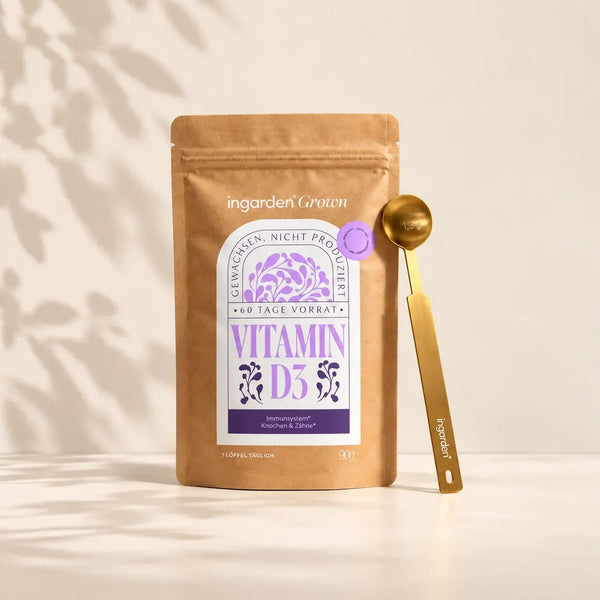
ingarden grown
Vitamin powder from sprouts
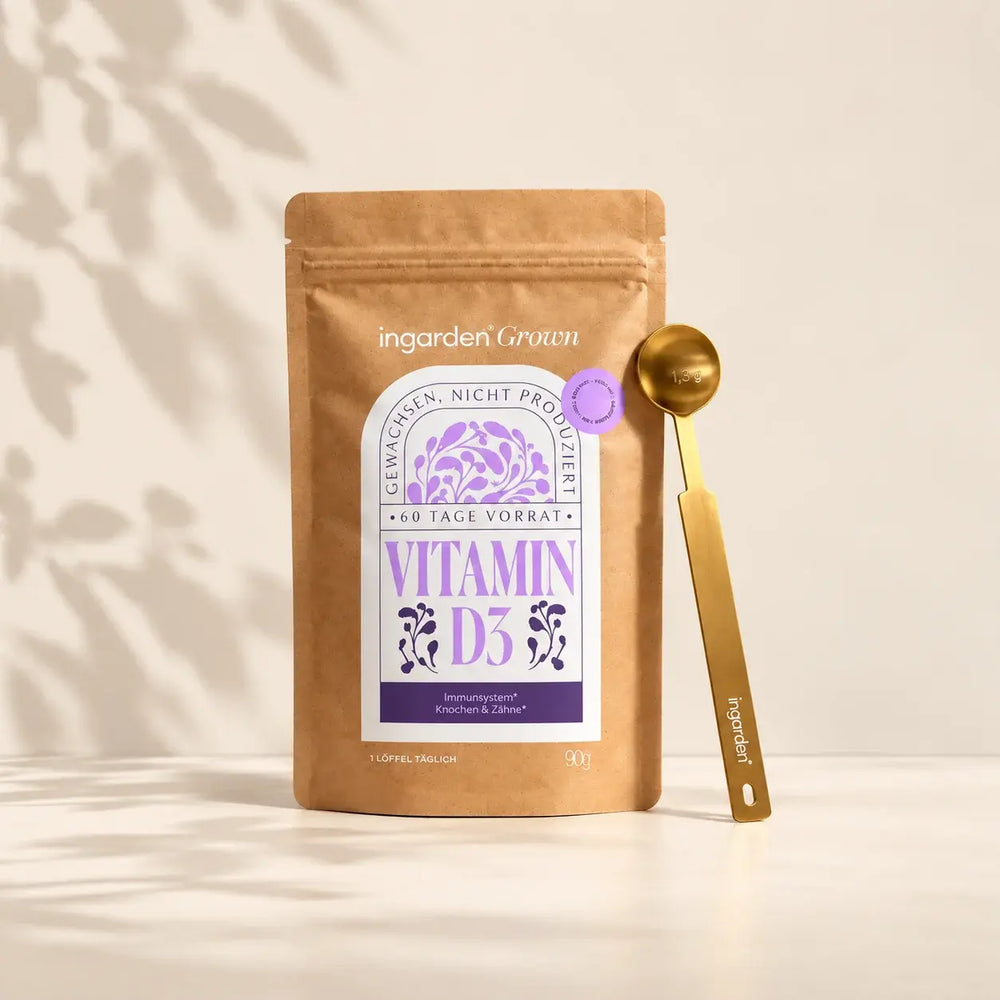
Vitamin D3 and all eight B vitamins, embedded in young buckwheat sprouts instead of isolated in a capsule. One spoonful a day, in water, a smoothie or your food.
Discover ingarden grown
 Grow your own
Enriched seed pads
Organic Mini Mustard Mg+
Organic seed pads with extra magnesium. You grow them in your ingarden and harvest them fresh after 7 days.
View seed pads
The principle compared
Scientifically studied
A synthetic pill only gives the body the raw material. The body first has to recognise it, absorb it and convert it, and loses a large part along the way. With ingarden, this work has already happened inside the plant.
Studies show that nutrients bound in the plant are absorbed better by the body than the same substances isolated in a lab.
* Study CuVi-16, Medical University of Vienna 2016: folic acid from sprouted buckwheat compared with isolated folic acid, 19 participants.
- Activation costs energyThe body first has to activate synthetic vitamins. With ingarden, you get them in their active form.
- Co-factors make the differenceIn the plant, vitamins work together with their natural co-factors. This makes them more stable and more effective.
- Ready to useingarden vitamins come in the form the body can use right away.
Sulforaphane compared (relative content)
100× Young broccoli microgreens contain up to 100× more sulforaphane than mature, cooked broccoli. Backed by research from Johns Hopkins University.
Cell protection
One of the best-researched plant compounds for cell protection
Sulforaphane switches on the body's own cell protection. Young broccoli microgreens are especially rich in it.
- Activation of over 200 cell-protective genes via the Nrf2 pathway
- Induction of phase II detoxification enzymes (glutathione S-transferase)
- Inhibition of the NF-κB inflammatory pathway
- Antioxidant capacity through histone deacetylase inhibition
- Clinically demonstrated bioavailability in humans (Shapiro et al. 2006)
Scientifically proven.
The key claims behind ingarden® and NutriMed™ are backed by independent, peer-reviewed studies.
ingarden commissioned an independent laboratory analysis of its own microgreen varieties compared with raw supermarket vegetables. The results show significant differences in nutrient density, per 100 g fresh weight: Mustard microgreens: 3,020% more vitamin C, 708% more lutein, 700% more vitamin K1, 373% more folic acid vs. processed yellow mustard. Radish microgreens: 29,900% more lutein, 5,700% more vitamin E, 4,623% more vitamin K1, 581% more manganese vs. raw supermarket radish. Broccoli microgreens: 424% more biotin, 169% more manganese, 150% more magnesium vs. raw supermarket broccoli. Red cabbage microgreens: 270% more manganese, 243% more calcium, 211% more choline, 200% more lutein, 140% more biotin vs. raw supermarket red cabbage. Kale microgreens: 2,213% more choline, 89% more biotin vs. raw supermarket kale. Arugula microgreens: 57% more iron, 56% more manganese, 51% more folic acid vs. raw supermarket arugula.
The biggest differences appear in secondary plant compounds such as lutein, choline and vitamin K – nutrients that are greatly reduced in regular supermarket vegetables through processing, storage and ripening. Harvesting microgreens means maximum nutrient density at the right moment.
The USDA's foundational study analysed 25 commercially available microgreen varieties for vitamin C, carotenoids, vitamin K and vitamin E. Result: on average, microgreens contained 4–40x higher concentrations of these nutrients than their mature counterparts.
This study laid the scientific foundation for the '40x more nutrients' claim, independently validated by the US Department of Agriculture. Not marketing, but measured reality.
A recent 2025 study analysed six microgreen species for nutrient profiles and antioxidant capacity. Black radish microgreens showed 83% DPPH radical scavenging capacity.
The superior antioxidant density of microgreens is not a historical finding – it continues to be confirmed by current research (2025).
A systematic analysis of the functional quality of microgreens from different genera. The study quantifies ascorbic acid, phenolics, carotenoids and antioxidant capacity, and shows that microgreens, as a concentrated source of functional plant compounds, consistently exceed the nutrient density of mature leafy vegetables.
It's not individual nutrients but the entire functional profile – phenolics, carotenoids, ascorbic acid – that is structurally superior in microgreens. That is systemic nutrient density, not an exception.
A comprehensive analysis of mineral concentrations in microgreens of various species compared with mature vegetables. The study documents significantly higher concentrations of calcium, magnesium, manganese, iron and zinc in microgreens.
Microgreens don't just deliver more vitamins – their superior nutrient density also shows in minerals. Eating microgreens regularly covers trace elements more efficiently.
Folic acid from sprouted buckwheat compared with isolated folic acid.
38% higher bioavailability of folic acid from buckwheat sprouts compared with pure folic acid. We also show this study for ingarden grown.
The study examines how intracellularly bound B vitamins from sprouted plants influence epigenetic processes. The focus: methylation as a key mechanism of gene regulation, and how plant-bound B vitamins support it more efficiently than synthetic equivalents.
Not just the amount, but the form and origin of B vitamins determine whether epigenetic protective processes are activated. NutriMed™ delivers exactly this form.
A randomised pilot study on the antioxidant effect of intracellularly bound B vitamins compared with isolated vitamins. Oxidative stress markers and cell protection biomarkers were measured over 12 weeks.
Intracellularly bound vitamins show a measurably superior antioxidant effect – not through a higher dose, but through better cellular integration.
A direct comparative study of bioavailability between the NutriMed™ principle (intracellular, plant-bound) and isolated synthetic B vitamins. Measured via serum levels and cellular uptake rate.
Plant-bound vitamins reach significantly higher serum levels at the same dose – the body absorbs what nature gives it.
A clinical study on the effect of the complete B vitamin complex on the frequency and severity of colds. Measured via infection rate, duration of illness and subjective well-being.
The complete B complex, especially in biologically active, plant-bound forms, shows measurable effects on everyday immune defence.
A study of the effects of B vitamins on stress management, energy metabolism and acid-base balance. The results show the systemic relevance of the complete B complex beyond the nervous system.
B vitamins are not a niche topic. They regulate energy production, the nervous system and acid-base balance – all systems that are challenged every day.
The pioneering Johns Hopkins University study was the first to show quantitatively that 3-day-old broccoli sprouts contain up to 100x more sulforaphane precursors than mature broccoli.
To get the same cell-protective effect as 500 g of mature broccoli, you only need 5 g of broccoli microgreens – harvestable every day in your ingarden.
A foundational study on the mechanism of action: sulforaphane specifically activates phase II enzymes (glutathione S-transferases, quinone reductase), which neutralise carcinogenic substances before they can cause DNA damage.
Sulforaphane doesn't protect reactively but preventively, by activating the cellular protection system before any stress occurs.
The first clinical study on the bioavailability and pharmacokinetics of sulforaphane from broccoli sprouts in humans. It demonstrated significant serum concentrations and measurable enzyme activation after consumption.
The active compound actually reaches where it is meant to work – the body absorbs it, and the effect is measurable.
Evidence of NF-kB pathway inhibition by sulforaphane. NF-kB is a central transcription factor in chronic inflammatory processes; its inhibition explains the anti-inflammatory effects of sulforaphane at the molecular level.
Sulforaphane doesn't just act against oxidative stress – it intervenes directly in inflammatory signalling pathways, which is relevant for chronic diseases associated with persistent inflammation.
Mechanistic evidence of Nrf2 activation by sulforaphane. Nrf2 regulates over 200 genes involved in cell protection, detoxification and stress resistance – a master switch of cellular health.
A single mechanism of action (sulforaphane -> Nrf2) activates a whole network of protective genes – broad-spectrum, systemic, preventive.
"Published studies show again and again that nutrients are absorbed better when they stay in their natural form. That's why we grow our vitamins in plant sprouts instead of making them in a lab."
Christian & Tess, founders of ingarden